These adorable apes are actually endangered in their home of Asia. They are endangered in Borneo putting their numbers at about 54,000. Unfortunately they are critically endangered in Sumatra putting their numbers at 6,500. Things like farming, logging, and burning of forests have destroyed about 80% of their home in the rainforest. Another issues is the Palm Oil plantations that are popping up and also destroying the rain forest. It was shown that about 800 orangutans are being lost a year due to habitat destruction. Also poaching is an issue with poachers kill the mothers and take the young orangutans and sell them into the illegal pet trade.
Although orangutans have been shown to be very flexible in their habitat and dietary needs their numbers are still declining. Part of that issue is the fact that their reproductive cycles take such a long time. In a previous post it was mentioned that gestation periods last about 9 months and that mother orangutans take care of their young till they are about 7 years old. This causes any repopulation to take a lot longer than it would with any other animal.
However there are many organizations that are taking the initiative to help the orangutans. For instance our own San Diego Zoo works in conservation efforts with the Orangutans. There area also many websites to be found of groups that have opened Orangutan Sanctuaries as well as groups that are trying to actively protect the Orangutan's habitat. There are many things we can do like just donating money to help the cause or even adopting your own orangutan (not literally of course), and of course just raising awareness even helps the cause.
sources:
http://www.sandiegozoo.org/animalbytes/t-orangutan.html
http://www.orangutanrepublik.org/become-aware/issues/orangutans-a-wildlife/threats-to-orangutans-mainmenu-5
http://orangutancentre.org/about-orangutan/
Monday, May 14, 2012

Orangutans at the San Diego Zoo!
If you haven't gotten a chance to see the Orangutans at the San Diego Zoo be sure to check them out next time you are there. I myself love going to watch these guys because they are usually right next to the observation glass so you can get a really good view of these animals. They can also be very entertaining! I watched them during feeding time once and its quite interesting to see them feed. Its clear they have favorite foods just like us. For example they seemed to ignore the lettuce being thrown at them but went directly for the fruit.
Their exhibit is quite interesting with lots of ropes to swing on and their are toys as well for them to play with. Below is a picture of the exhibit. On the right side of the picture you can see a rock like structure. This plays as a fake termite mound that the Orangutans can interact with. The keepers put barbeque sauce or ketchup or honey in the holes of the mound and the Orangutans have to get it out some way to get the treat.

Their exhibit is quite interesting with lots of ropes to swing on and their are toys as well for them to play with. Below is a picture of the exhibit. On the right side of the picture you can see a rock like structure. This plays as a fake termite mound that the Orangutans can interact with. The keepers put barbeque sauce or ketchup or honey in the holes of the mound and the Orangutans have to get it out some way to get the treat.
 |
Orangutan Exhibit |
Here you can see one of the female Orangutans just rolling around on the ground having a great time!

Thursday, May 3, 2012
Lets Get it On
Orangutan Reproduction:
Orangutans reproduce very slowly so there is a lot of competition between males to find females. Females are attracted to flanged males. There are two types of males in the Orangutan populations, flanged and unflanged. Flanged males are the larger of the two with cheek pads, throat pouches and longer hair. On the other hand females are still very selective in their mating process and will turn away any male that doesnt fit her fancy. Unfortunately this has led to some males forcing females into copulation. Most of the time the larger male wins and the smaller males are left with nothing. We can also define this system as short term polygyny.
The females reproductive stage lasts about 9 months, similar to humans. Females also don't show external signs of estrus or menstruation. Their reproductive cycles last about 30 days. Every 6-7 years a female will give birth to an offspring. They usually raise and stay in contact with their young for the first 7 years of its life.A female is considered to have reached adulthood when they have their first offspring. This whole process is very costly because it is so long and she is taking care of not only herself but of her infant as well.
Sources:
Orangutans reproduce very slowly so there is a lot of competition between males to find females. Females are attracted to flanged males. There are two types of males in the Orangutan populations, flanged and unflanged. Flanged males are the larger of the two with cheek pads, throat pouches and longer hair. On the other hand females are still very selective in their mating process and will turn away any male that doesnt fit her fancy. Unfortunately this has led to some males forcing females into copulation. Most of the time the larger male wins and the smaller males are left with nothing. We can also define this system as short term polygyny.
 |
| Flanges Male Orangutan |
 |
| Orangutan baby and mother |
Sources:
Sunday, April 8, 2012
Epic Orangutan Meal Time
 |
| Orangutan in a zoo enjoying some lettuce |
Orangutans spend up to 6 hours a day eating or foraging for food. In fact all they really do during the day is eat, look for food, rest, and move to a different location to look for food. Orangutan diet varies over all the different populations of Orangutans.
About 90% of Orangutans diet consists of fruit. They have been known to eat over 400 different plant varieties. Since fruit is such a big part of Orangutans diets they are a big help ecologically. Some seeds in the tropical rainforest will only sprout after being passed through an animal's digestive system, making orangutans vital as seed dispersers. Orangutans don't only eat fruit, they require other nutrients from different plants and nuts as well. Most of the time Orangutans get their water intake from the fruits they eat, although they will also drink from rivers and streams.
Orangutans eat more than just fruit. They also will eat insects such as ants, termites, caterpillars,etc. In some cases Orangutans have been known to eat small animals such as slow lorises. Some Orangutans have also been seen eating figs or honey.
Some of the Orangutans favorite fruit (Nothing like we eat!)
 |
| Durian |
 |
| Jackfruit |
 |
| Rambutan |
Eating habits:
Orangutans are smart creatures and can memorize temporary food locations during seasonal times, they can also track the location of different food sources based on the behavior of other animals.
Orangutans are able to strip leaves from branches by dragging it through their mouths. They also consume soil to help with the digestion of plant materials. They are also able to reduce feeding competition by using their strong jaw to open the hard shells of some fruit or nuts before they are ripe. Therefore getting to the food before another species does.
 |
| a young Orangutan having a snack |
http://www.orangutan.org.uk/about-orangutans/diet
http://www.orangutan.nl/orangutan_behaviour.htm
http://www.seaworld.org/animal-info/info-books/orangutan/diet.htm
Scholarly article: Tool Use
The article "Intra- and interpopulational differences in Orangutans (Pongo pygmaeus) activity and diet: Implications for the invention of tool use" Written by Elizabeth A. Fox, Carel P, van Schaik, Arnold Sitompul, and Donielle M. Wright. This article was first published January 12, 2004 in the journal American Journal of Physical Anthropology.
To summarize the article:
We know that Orangutans have been known to use tools, they question that is raised is what prompts them to use these tools and why. They studied Orangutans from the Suaq Balimbing Research Station in Sumatra, Indonesia. Their initial hypothesis was that Orangutans were using tools because of a low availability of primary food sources, however they found that tools were more likely used for invention of extracting a food source (such as insects). It was found that at this research station most of the Orangutans present main diet consisted of insects that occupied tree holes and required tool use to extract them. These insects consisted of stingless bees (including their honey), ants, and termites. They found that there was no difference between male and female tool use, as well as no difference within the genders. Females in a reproductive state like pregnant or lactating, did in fact consume more energy rich insects, however their tool use to extract those insects didn't increase in those time periods. In regards to this population tool use is mainly to increase the efficiency of insect foraging. Orangutan diet varies across different populations so it's hard to come to any concrete conclusion about the idea of tool use within this species after studying only one population.
Citation
Fox, E. A, van Schaik, C.P., Sitompul, A. and Wright, D.N.
(2004), Intra- and interpopulational differences in orangutan (Pongo pygmaeus) activity and diet:
Implications for the invention of tool use. Am J. Phys. Anthropol. 125:
162-174. Doi: 10.1002/ajpa.10386
Orangutans Evolution
the classification of orangutans is as follows:


Kingdom: Animalia
Phylum: Chordata
Class: Mammalia
Order: Primates
Famiy: Pongidae (which include the great apes)
Genus: Pongo
Species: pygmaeus
Modern Orangutans first originated during the Pleistocene period about 2 million to 100,000 years ago. There are debates on what species they evolved from we know however they did evolve from the great ape family (which they are still a member of today) We know that in this time period Orangutans were about 30% larger than they are today. While Orangutans were evolving in Asia at this time period, other primates were evolving into early human species.

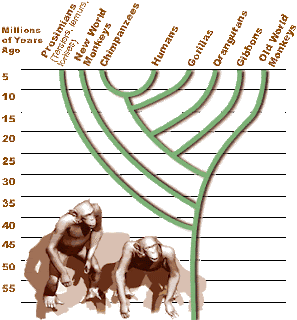
Here is a primate evolutionary tree
Throughout the years there has been debate on if their are actually subspecies of Orangutans that evolved. One being Pongo pygmaeus pygmaeus found on the islands of Borneo and Pongo pygmaeus abelii found on the island of Sumatra. Some researchers think that these are two very different species of Orangutans because they look sightly different and live in different area. On the other hand some researchers believe that they are all the same species and just differ in physical attributes. What do you think? Pictured below is a Bornean Orangutan on the top and a Sumatran on the bottom. See the difference?
Subspecies or not they are a member of the great ape family along with Gorillas, Chimpanzees, Gibbons, Bonobos. Like other great apes, Orangutans genome has been studied and found that it is quite similar to our human genome. The reason we should study primates is because we know that humans evolved from them and by researching our early ancestors could possibly tell us something about ourselves.
Links:
Tuesday, March 13, 2012
Just like us?
http://www.youtube.com/watch?v=IFACrIx5SZ0
Here is a really cool video that shows Orangutans and how they can mimic human behavior. I myself have been able to witness Orangutans mimicking human behavior. I was observing an Orangutan at Busch Gardens in Tampa Bay Florida. The Orangutan took a shirt that was given to her as a form of enrichment (aka a toy) and she took the shirt and ripped it in half (orangutans are very strong) and she tied it to a branch in her enclosure and made a swing out of it. She sat there for a good 10 minutes swinging around until she got bored then untied the shirt and made a necklace out of it. It was very funny to watch. It really goes to show that if you observe these animals for a while (and they observe you back) they will pick up on human tendencies.
Here is a really cool video that shows Orangutans and how they can mimic human behavior. I myself have been able to witness Orangutans mimicking human behavior. I was observing an Orangutan at Busch Gardens in Tampa Bay Florida. The Orangutan took a shirt that was given to her as a form of enrichment (aka a toy) and she took the shirt and ripped it in half (orangutans are very strong) and she tied it to a branch in her enclosure and made a swing out of it. She sat there for a good 10 minutes swinging around until she got bored then untied the shirt and made a necklace out of it. It was very funny to watch. It really goes to show that if you observe these animals for a while (and they observe you back) they will pick up on human tendencies.
Subscribe to:
Posts (Atom)